
Live performance reimagined: driving participation and embracing uncertainty with MASS

Live music has long followed a familiar format: a performer on stage, an audience watching from a distance. MASS, an experimental performance project developed by Pod Bluman and Barney Kass, explores an alternative approach – one where audiences actively participate in shaping the performance itself.
The project brings together real-time technology, audience interaction and live music within a shared environment.
What is MASS?
“MASS is an ecosystem for performance which allows the audience to participate and collaborate in the performance,” explains Bluman. “It’s about using technology as a medium, but not making it the focus.”
Rather than centering the experience around screens or spectacle, MASS focuses on connection. It rethinks the structure of a typical live music event by inviting the audience into the creative process, reducing the separation between performer and spectator.
“It feels like artists are getting further and further away from the audience in these massive stadium shows,” Bluman says. “We wanted to use technology to connect in a more meaningful and empowering way’”
A three-year development journey
The concept for MASS began around three years ago, starting with small-scale experiments in Bluman’s studio.
“We started with a small pilot,” he says. “It quickly became clear that people weren’t just watching, but they were testing it, playing with it, trying to understand how their actions were shaping the experience.”
From there, the project developed gradually through testing, iteration and informal demonstrations. The team continued refining both the creative concept and the technical system, inviting people to experience early versions and provide feedback.
This process eventually led to support from the CoSTAR network, which accelerated development through funding and structured research.
Working within CoSTAR’s Futures Studio at Royal Holloway, the team undertook a focused research sprint. This included building and refining the system, developing content and testing user experience in a controlled environment.
A pilot event formed part of this process, where audience members were invited to take part and complete surveys designed by an academic research unit.
“That data was incredibly valuable,” says Bluman. “It gave us insight into how people experienced MASS and helped shape the next stage of development.”
One key finding was that participants were not always immediately aware of how their interactions affected the system. This led to a design decision around how much of the experience should be explained upfront.
The team chose to withhold certain information about the mechanics, encouraging audiences to explore and gradually understand how their interactions could influence the system.
“We decided to demonstrate how it worked rather than explain it,” Bluman explains. “That meant some people might feel uncertain, but it also encouraged curiosity.”
Participation as part of the performance
MASS builds on wider experimentation in immersive and interactive design, where audiences take on a more active role.
“There have been lots of steps towards participation,” Bluman says. “Audiences are becoming less passive and more active, and I think we’ve taken it a step further with MASS.”
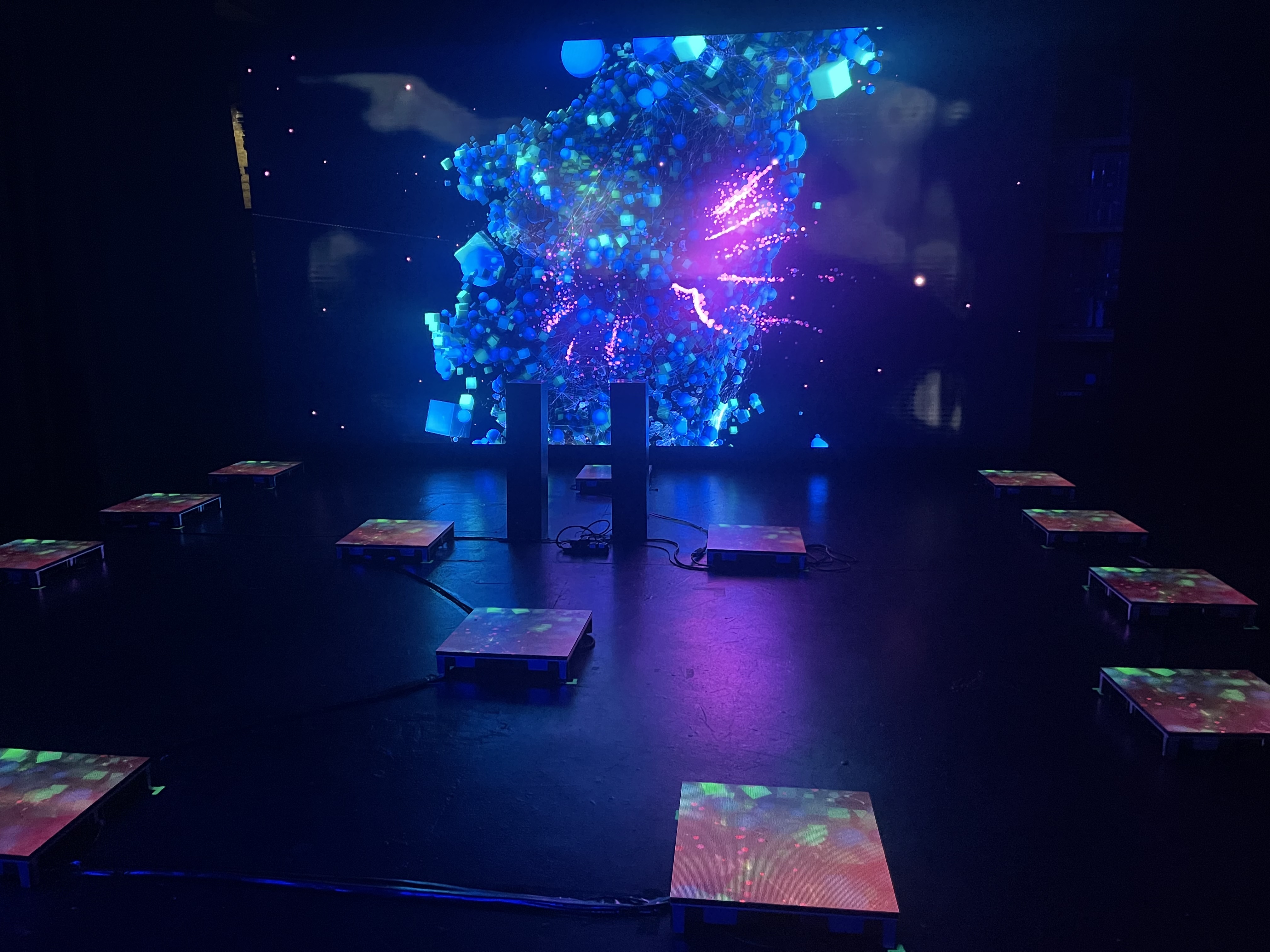
The system is structured around a series of live performances, each shaped in part by audience input. Within the space, LED floor tiles are distributed across the environment. When stepped on, each tile triggers changes to both visuals and audio in real time. Each tile is programmed differently, and its behaviour can change between tracks. A tile that triggers one effect during one moment in the performance may produce something entirely different later on.
This creates a shared, evolving environment where audience members influence the outcome without fully controlling it.
Designing with uncertainty
A central aspect of MASS is its acceptance of unpredictability.
“I think one of the parameters that immersive and interactive designers have often shied away from is uncertainty,” Bluman says. “That’s something we tried to embrace.”
With multiple people interacting at once, the system produces outcomes that cannot be fully anticipated. Even the artist hears a version of the performance that differs from the original composition.
“When there are 20 people all participating at once, the version of the music the artist hears isn’t the version they created,” he explains. “It’s different every time.”
This approach shifts the role of both artist and audience. The performance becomes something that is continuously shaped in real time, rather than something fixed in advance.
Bringing MASS to life
The final performances brought together around 150 attendees in a shared, open space.
Artists performed within the audience rather than on a separate stage, helping to demonstrate how the system could be used. Audience members were free to move through the space, interact with the tiles and influence the experience as it unfolded.
The technical system supporting this interaction combined real-time rendering and tracking technologies. LiDAR-based sensors were used to detect when participants stepped onto tiles, with data routed through Stage Precision to trigger events across the system. These signals drove visual content created in Notch and played back via Disguise GX 3 media servers, enabling responsive changes across both audio and visual layers.
The experience itself remained intentionally open-ended. There was no single way to engage, and no fixed outcome.
Feedback from attendees reflected this. Many described the experience as engaging and unusual, while also noting moments of uncertainty about what to do or how their actions translated into results.
“There was a real sense of excitement,” Bluman says. “People knew they were part of something different. It created curiosity.”
Looking ahead
MASS does not position itself as a replacement for existing live performance formats. Instead, it acts as an exploration of what happens when audiences are invited into the creative process.
After three years of development, the project has established a foundation for further experimentation. Its future will depend on new opportunities for collaboration, funding and research.
For Bluman, the focus remains on continuing that exploration.
“It’s something I believe in,” he says. “I’d love to keep developing it and see where it can go.”