
How to build the business case for a stadium visual experience
Sports

A stadium AV upgrade can give your commercial team new sponsorship formats to sell and your game presentation team more creative freedom. Making that investment worthwhile starts with a clear view of what your venue needs to deliver.
You could be refreshing matchday presentation across the main screen and ribbon boards, introducing interactive fan experiences or preparing an arena for a wider range of events. Each ambition brings different requirements for content, technology and the people running the show.
Whether you’re upgrading an existing venue or planning a new build, here’s how to connect the creative possibilities with a practical business case.
Start with a clear venue objective
Agree what the project should achieve before deciding on the technology. Describe what needs to improve and the effect it has today - if manual sponsor updates limit the activations your team can deliver, record the time involved and the impact on the event programme. Connect the change to a real deadline, such as a sponsorship renewal or venue reopening.
Choose one use case to develop in detail - for a sponsored player introduction, define when it happens, which displays it uses and what content the team needs to create. Then identify who approves it and who delivers it on matchday.
That gives everyone a shared brief and makes it easier to assess proposals against the same objective.
Bring the budget owner into the plan
Identify the person with final authority to fund the project and agree what they need to see. Show the full investment, including content and ongoing operation, alongside the expected commercial or operational return. Make the assumptions visible so finance can assess the case.
Name an internal sponsor who can build support across venue teams. Give them a concise business case they can take to the budget owner, backed by a visual proposal and evidence from the people who will use the system.
Give sponsors an experience they can see
Coordinated visual content can help commercial teams develop offers that span multiple displays. A sponsor takeover could connect the main screen and ribbon boards at a key moment in the show. A branded game during a break could give fans a role in the activation.
Develop the format with sponsors and your production team. Agree what the package includes, how often it runs and what it costs to produce and update. Those details help establish its commercial value.
Previsualisation brings the proposal into focus. Using a three-dimensional model of the venue, teams can review how content appears across different surfaces before it goes live. It gives commercial teams a way to demonstrate an activation and helps stakeholders agree the creative direction.
Use live content to bring fans into the experience
Real-time graphics use live inputs, such as player statistics or tracking data, to change what appears on screen. That creates scope for reactive visuals and participation at selected moments in the event schedule.
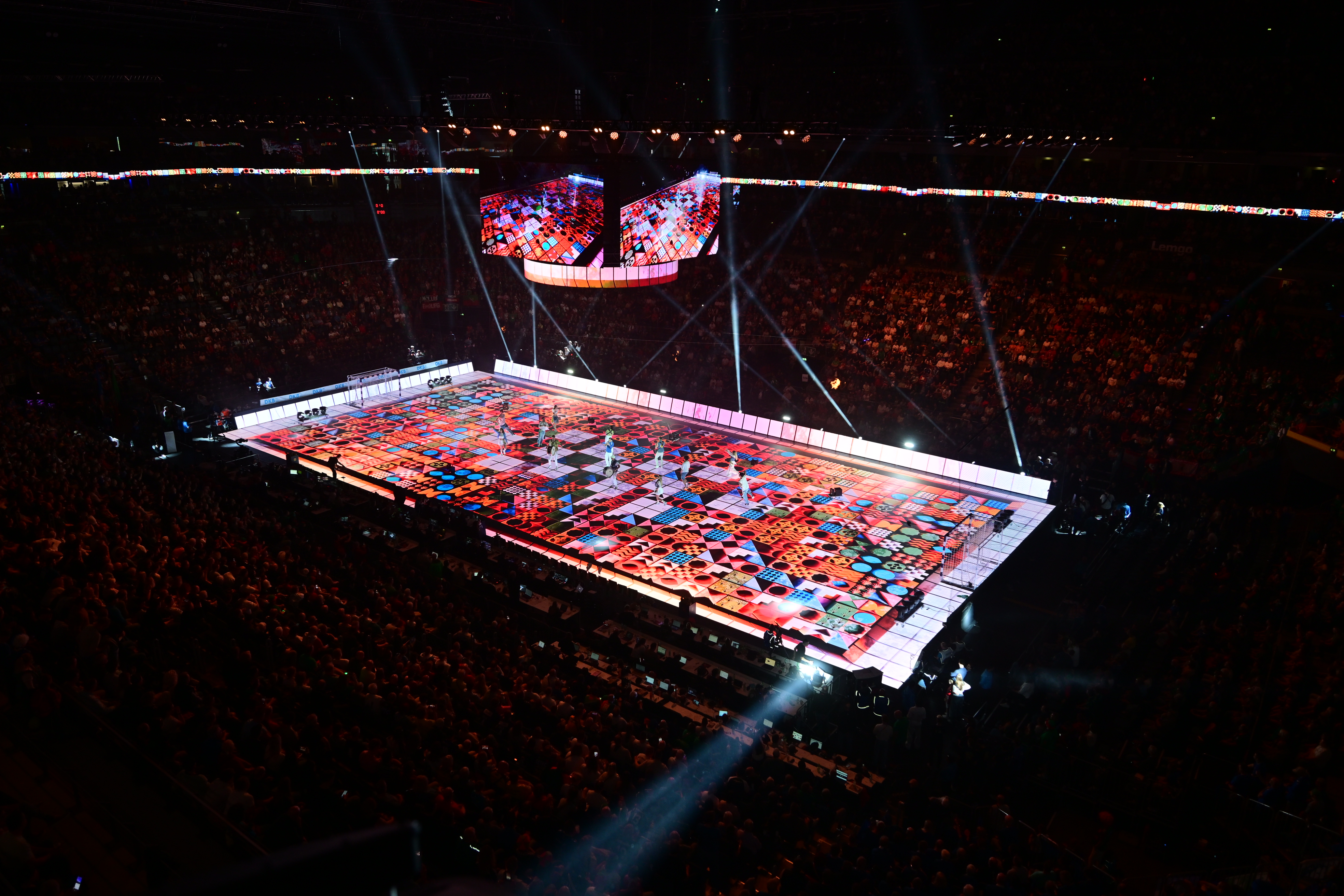
At the Lidl Final4 tournament in Cologne, PlanValley combined our media servers with ASB GlassFloor’s video flooring and Kinexon tracking to create an interactive half-time game. Fans stepped onto the court to jump between moving targets that disappeared beneath them.
The team also used our Designer software to map content across the floor, jumbotron and ribbon displays. As PlanValley’s Aron Klauke explained:
“Disguise’s Designer software enabled us to map content across the floor, jumbotron, and ribbons.”
For your venue, start with a moment where participation adds to the event. Define the activity and the resources needed to run it, then build the experience around the fans taking part.
Plan for the team running the venue
The operating plan deserves the same attention as the creative idea. Decide which parts need specialist production and which should become repeatable tasks for your venue team.
A new interactive experience may need a creative partner to develop it. A recurring sponsor sequence needs a clear process for changing branding, checking the content and triggering it during the show. Plan the controls around those tasks and the people responsible for them.
Include content creation, integration, training and ongoing support in the budget. Allow time for rehearsals and agree how the team will respond if a component fails. These decisions help turn the initial installation into a system the venue can operate with confidence.
Build around your venue and event calendar
For an existing stadium, begin with the displays, control systems and workflows already in place. Review where coordinated playback, projection or live graphics would add value, and what integration the proposed experience requires.
Projection mapping can extend content onto suitable architectural surfaces or a playing surface. Assess sightlines, lighting conditions and access alongside the creative concept to understand where it will work.
For a new build, bring commercial, creative and technical stakeholders into the design process early. Consultants and integrators need to understand the experiences the venue plans to deliver, as well as the physical installation.
Use your event calendar to test the brief. A venue hosting sport, concerts and corporate events needs to account for different content requirements and changeover schedules. Assess the value of that flexibility alongside your booking strategy and the resources available to support it.
Agree how you will compare the options
Agree what each option must demonstrate. Start with the priority experience and how it will work with existing systems. Then assess the operator’s tasks, recovery if a component fails and the cost of ownership.
Use the same criteria to compare a new platform, an upgrade to existing tools or a phased rollout. Include the ongoing cost and limits of the current approach so decision-makers can judge the value of change.
Agree how you will measure success
Agree the measures with the person approving the investment. Record a baseline, a target and a review date so the business case states what success will look like. Depending on the brief, measures could include:
- Sponsorship packages sold and contribution after production and delivery costs.
- Production and content update costs.
- Participation in a specific fan activity.
- Content preparation and event changeover time.
- Playback incidents and the time taken to restore service.
Give each measure an owner and compare results with the agreed target. Use the findings to refine the experience and decide where to invest next.
Work back from your first event
Map the steps from technical evaluation and budget approval to supplier onboarding, contract review and purchase orders. Confirm who owns each decision and the time they need.
Agree the acceptance checks with your venue team and allow time for integration, training and rehearsals. Work back from the first event to set realistic approval dates.
Bring the plan to life with Disguise
Our stadium and arena solutions bring together media server hardware, software, creative and technical services, training and support. We help teams plan and deliver visual content across venue screens and projection, from previsualisation and system design through to content delivery and operator training.
A clear brief gives us and your delivery partners a useful starting point. Share what you want the venue to achieve, the systems you have today and your project timeline.
Our ebook, The Future of Stadiums and Arenas: Beyond the Game, explores five opportunities for your venue, with examples of real-time graphics, interactive experiences and new sponsorship formats.
Learn more