
Maybe Happy Ending delivers Tony Award-winning design with Disguise
Live Events
Theatre & Opera
Disguise Platform

LED screens and video content have become a dynamic and powerful part of modern theatre design, enhancing storytelling possibilities for show creators. Underlining this point, video designer George Reeve's work on Maybe Happy Ending was recently recognised with the Tony Award for Best Scenic Design. Sharing the honour with scenic designer Dane Laffrey, Reeve’s contributions were not just visually stunning - they were essential to the emotional and narrative arc of the show.
Set in Seoul in the not-too-distant future, the musical tells the story of two human-like helper robots, Oliver and Claire. Over the course of the show, they develop a connection that challenges what they believe is possible for themselves, exploring relationships, love and even mortality. To help bring the production’s futuristic Seoul setting to life, the creative team wanted to create a seamless blend of video and stagecraft that leaves the audience unable to discern the digital from the physical.
With Disguise having powered video-driven stage spectacles including Redwood, Stranger Things: The First Shadow and Disney’s Hercules, Reeve and system designer Chelsea Zalikowski were in no doubt about which tools to use on this pioneering production.

The challenge
“Theatre usually uses video to solve technical problems that traditional stagecraft can’t,” explains Reeve. “On Maybe Happy Ending, we wanted to use video for storytelling purposes, as an extension of the on-stage elements. When Oliver and Claire leave their tiny box apartments, we go on a journey with them, and video supports their adventure the whole way through. At times subtly gesturing to the motion of a road and passing buildings, to a bustling ferry terminal and wide open landscapes. The content on the LED tiles combines with lighting and stagecraft to show the expansiveness of the scenery that surrounds them.”
Reeve typically designs content in 4K layers, and is no stranger to pushing media servers to their limits. However, the staging of Maybe Happy Ending incorporates 450 LED tiles and multiple surfaces covering the ceiling, back wall, floors and proscenium - more than any other show currently on Broadway. With the sheer volume of video being used, the team needed to know their visual-driven show could run without issue night after night, whilst also providing them with the content flexibility that they needed.
The sight lines of the Belasco Theatre’s wide seating area also posed a potential issue. When planning complex sequences that blurred the lines of reality - such as a pivotal moment where an on-stage actor interacts with a holographic character - the team needed to consider what these effects would look like from the perspective of every audience member.
All of these challenges were compounded by the tight turnaround, with just two months to build out the content before the curtain went up - incredibly ambitious for a show of this scale.

The solution
Having used Disguise on several theatre projects, Reeve and Zalikowski knew that Disguise VX media servers and Designer software would have the strength and reliability to power Maybe Happy Ending’s video content.
Designer’s pre-programming and visualisation capabilities made designing the video content on such a tight timeline possible. The system even enabled them to make quick changes based on sight line issues in the theatre. “Video can’t respond as quickly as lighting or sound,” says Reeve. “We have to create assets and throw ideas together quickly. The value of being able to work out what you might need ahead of time by doing previs is huge.”
There’s no other media server we could have done this show on. It was important to use software that we knew and felt comfortable with.
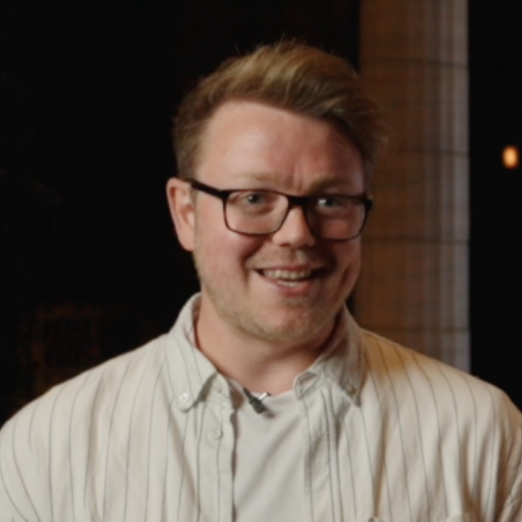
Video Designer, Maybe Happy Ending
Previz was used to envisage how each video sequence would play, allowing them to consider how to bake it down and what elements could be composited down. Reeve also used Coloured Layers to keep track of the many layers, surfaces and key frames in his project file, simplifying the workflow and ensuring he could respond quickly to any changes in the room.
To realise the hologram sequence, the creative team projected onto hologauze to create the illusion of 3D, with projections also running on Disguise. Video content layered underneath accentuates the effect and leaves viewers questioning what’s physically on stage and what’s not. The edges of each LED screen are disguised with neon LED tape that extends into the content itself, resulting in a seamless blend of lighting, scenery and video that leaves audiences in wonder.
The results
Maybe Happy Ending opened at the Belasco Theatre on Broadway in late 2024 and immediately captured the imaginations of audiences and critics. It earned 10 nominations at the 78th Tony Awards and won six, including Best Musical.
“It’s rare to be part of a piece of theatre that’s so completely original,” says Reeve. “I’ll forever be proud that our team could change the perception that video is just for stage backdrops. Going forward, I’d love to see the boundaries between theatre departments continue to blur. Video and traditional elements can go hand in hand to deliver unforgettable art.”
Discover more Disguise-powered theatre
